One of the questions we hear most often right now is this: “We have a lot of very small categories of workers under the EU Pay Transparency Directive (EUPTD). Can we combine groups so the regression has enough power?”
The short answer: sometimes larger groups are helpful, but you should not create artificial groups just to make the statistics work.
Under the EUPTD, organizations are expected to compare pay by category of workers which equates to employees performing the same work or work of equal value. In practice, many organizations define those groups using some combination of level, business entity, geography, and job focus.
The challenge is clear. Once you slice the data that way, some groups become very small very quickly. When groups drop below roughly 30 employees, one or two people can dramatically shift the observed gender pay gap. Outliers matter more. Statistical controls become less stable.
Small data quirks suddenly look like major pay equity issues.
That does not mean the analysis is wrong. It just means you need to handle small groups differently.
Larger groups can be better, but only when they are legitimate
There is nothing inherently wrong with having larger categories of workers if those categories still reflect the same work or work of equal value. In fact, larger groups often produce more reliable outcomes.
Why?
First, larger populations naturally reduce noise. One unusually high-paid or low-paid employee matters less when there are 200 employees in the group instead of eight.
Second, statistical controls require data to be effective. Controls for things like job family, tenure, or location can help distinguish between structural pay differences and actual gender pay gaps. Unfortunately, you can’t control for much in small groups, which severely limits your ability to account for structural pay differences.
Under the directive, both of these problems are important because the threshold for concerning pay differences by gender is 5% and not statistical significance. In this situation small groups and groups with a lot of control variables work against you because statistical noise alone can easily bring gaps above that threshold.
But there is an important distinction here. There is a big difference between:
- using a legitimately broader category of workers, and
- creating new analysis groups purely to increase sample size.
The second approach creates problems that will cost you downstream.
Don’t build artificial structures for the analysis
A common pattern looks like this: A company defines categories of workers based on the company’s job architecture. A few groups show pay gaps above 5%. Then the regression analysis fails to explain those gaps because the small group generates volatile results and doesn’t allow for statistical controls. One temptation is to address this problem by merging adjacent groups until the model becomes statistically stable.
That is where organizations start getting into risky territory.
The analysis should follow your compensation structure, not create a parallel structure just for the model. Any review of your analysis would call you out on that: “If you think that those groups are within the same category of worker, why is that not represented in your job architecture?”
Instead of widening the group of workers, the better approach is to investigate the small group more carefully.
What to do instead: How to best approach small groups
1. Look for outliers first
Before assuming there is a systemic issue, look at the underlying distribution. In small groups, one employee often explains most of the observed gap.
In the example below, there is only one woman in the category. The apparent gap is heavily influenced by a single high-paid male outlier.
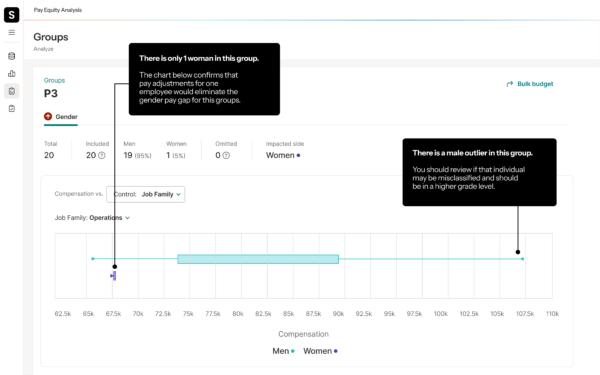
That is a very different situation from a broad pattern where women are consistently paid less across the group.
Key takeaway: The point is not to dismiss the result. The point is to understand what is actually driving it.
2. Be very deliberate when it comes to statistical controls
Sometimes organizations apply so many controls that employees effectively lose meaningful comparators. This is one of the biggest issues we see in small-group analyses.
For example, after controlling for job family, you may end up with only one man and one woman left that can actually be compared. At that point, the “group pay gap” is really just the pay difference between two people.
Key takeaway: Small groups require more judgment and more context. Only include the controls that really matter.
3. Review range placement and leveling
Many small-group issues turn out to be classification problems rather than compensation problems.
For example, someone sitting far outside the expected range for their level can create a large apparent gap on their own. The problem is often not the pay level but rather that the employee is misclassified or grandfathered. Misclassification can be solved by moving the employee to a different category of worker.
Key takeaway: It’s easier to fix and defend those types of classification situations than it is to redesign the comparison group.
4. Bring in local compensation context
Local compensation professionals and HRBPs often already know why a specific employee is paid differently. For instance, differences in pay could be due to a retention adjustment, a critical skill premium, a recent market correction, or a leveling issue still being resolved.
The best analyses combine rigorous statistics with practical compensation knowledge and context.
Key takeaway: The directive does not explicitly require you to conduct a quantitative analysis to explain pay gaps. It’s possible to explain qualitatively why pay differs among employees. If your labor organization (the union or the works council) agrees with your rationale, then you are done.
Don’t combine groups just for the EUPTD analysis
Small groups are one of the most challenging parts of EUPTD implementation. But creating alternative comparison structures just to improve model performance is not the answer.
The most defensible analyses are typically the ones that stay closest to the organization’s real job architecture.
If the same category of workers holds consistently across reporting, analysis, joint pay assessments, and employee information requests, you are usually on much firmer ground even if some of the groups are small.
How Syndio helps you comply and tackle what’s next
The Syndio platform is built to simplify the most complex parts of EU Pay Transparency compliance, including small groups analysis, with a technology platform and embedded expert guidance that makes your results defensible. And once your compliance foundation is in place, the same platform ensures every pay decision your organization makes is fair, optimized to budget, and aligned to your strategy. That means no surprises at reporting time, lower remediation costs, and pay decisions that are compliant and explainable from the start.