This transposition tracker was originally published on June 26, 2024. It was last updated on March 2, 2026.
We are in a new era of transparency. The EU Pay Transparency Directive is the most comprehensive piece of pay and workplace equity law in the world enacted since the 1960s. It is posed to change workplace equity in Europe — and also around the globe, if the ongoing trend of global cross-pollination of workplace equity continues.
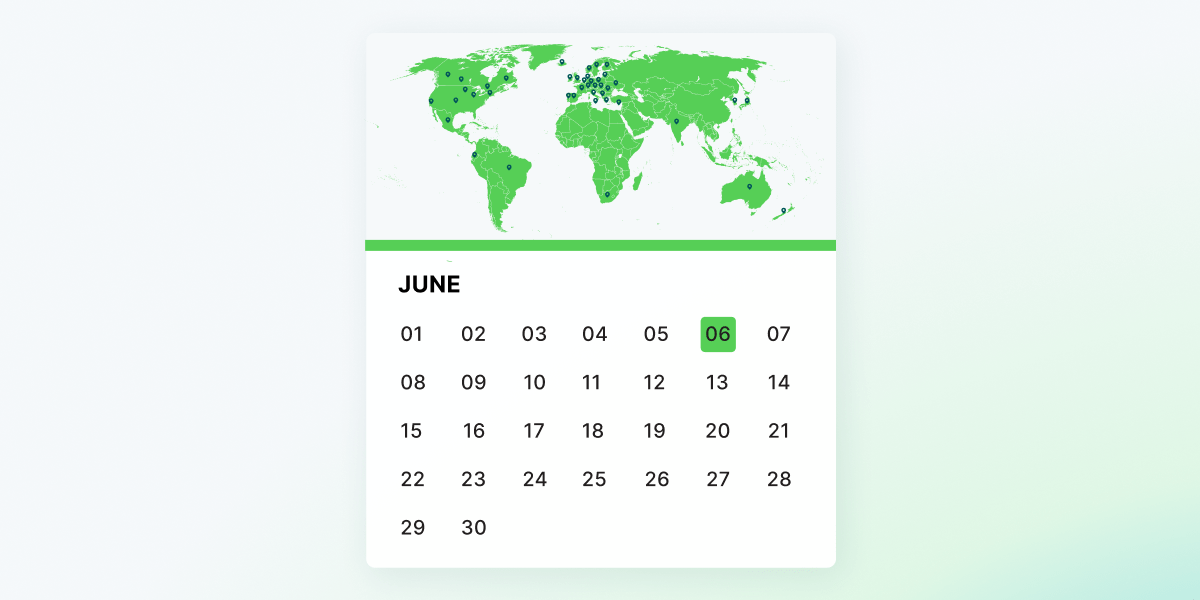
The EU Pay Transparency Directive now must be transposed by each of the 27 member states in the European Union. The clock is ticking: member states have only until 7 June 2026 to transpose the Directive into local law.
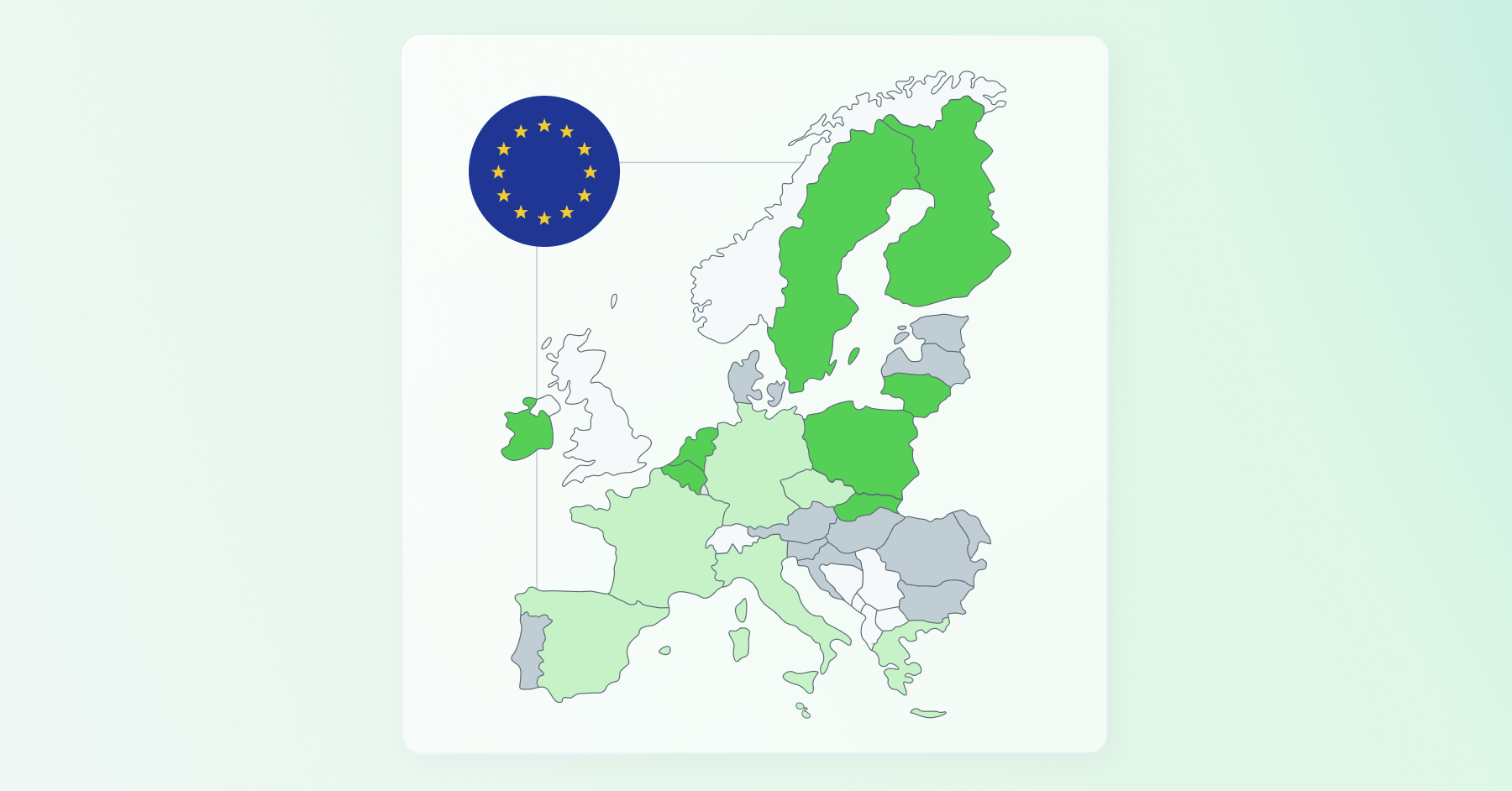
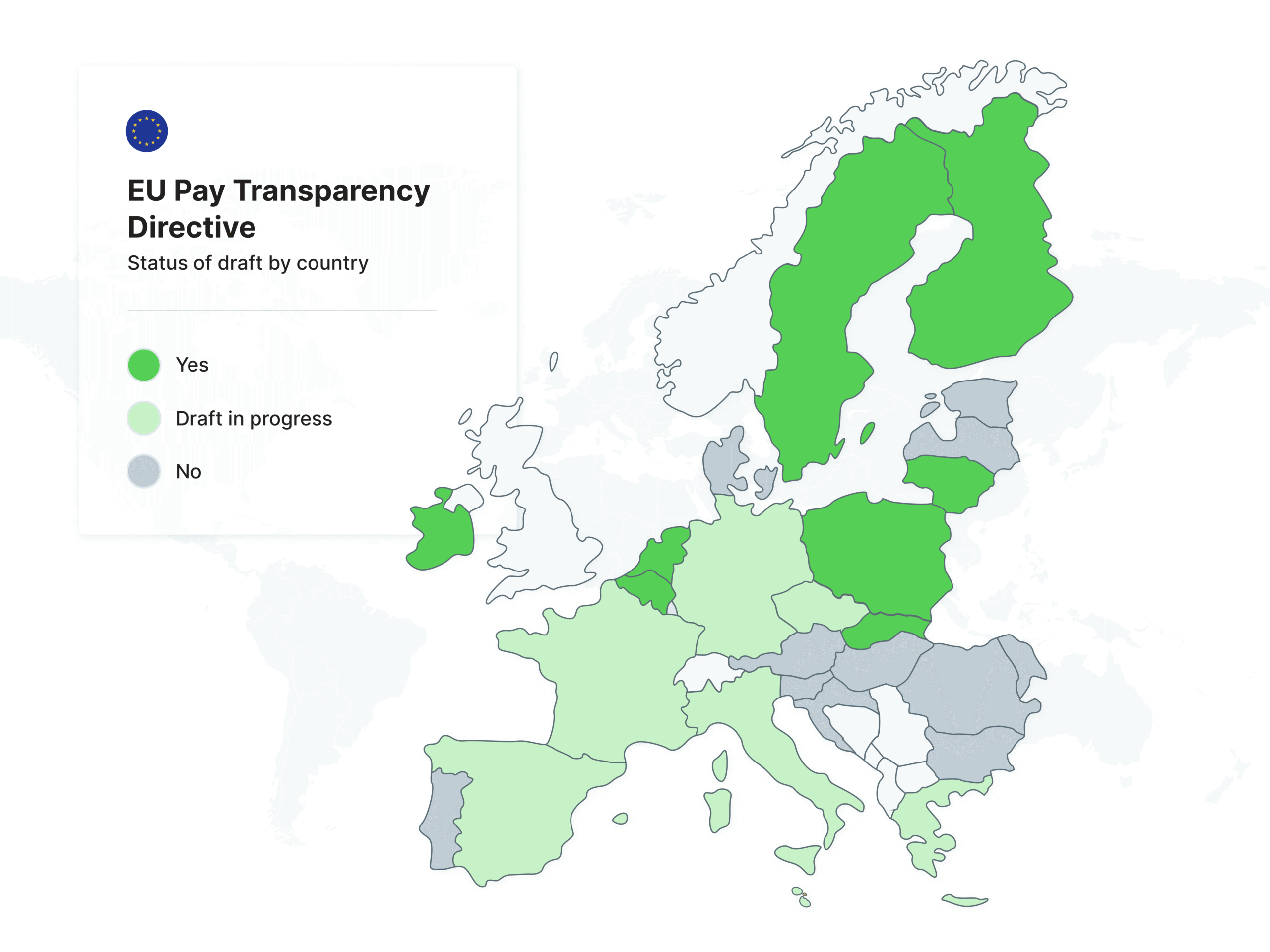
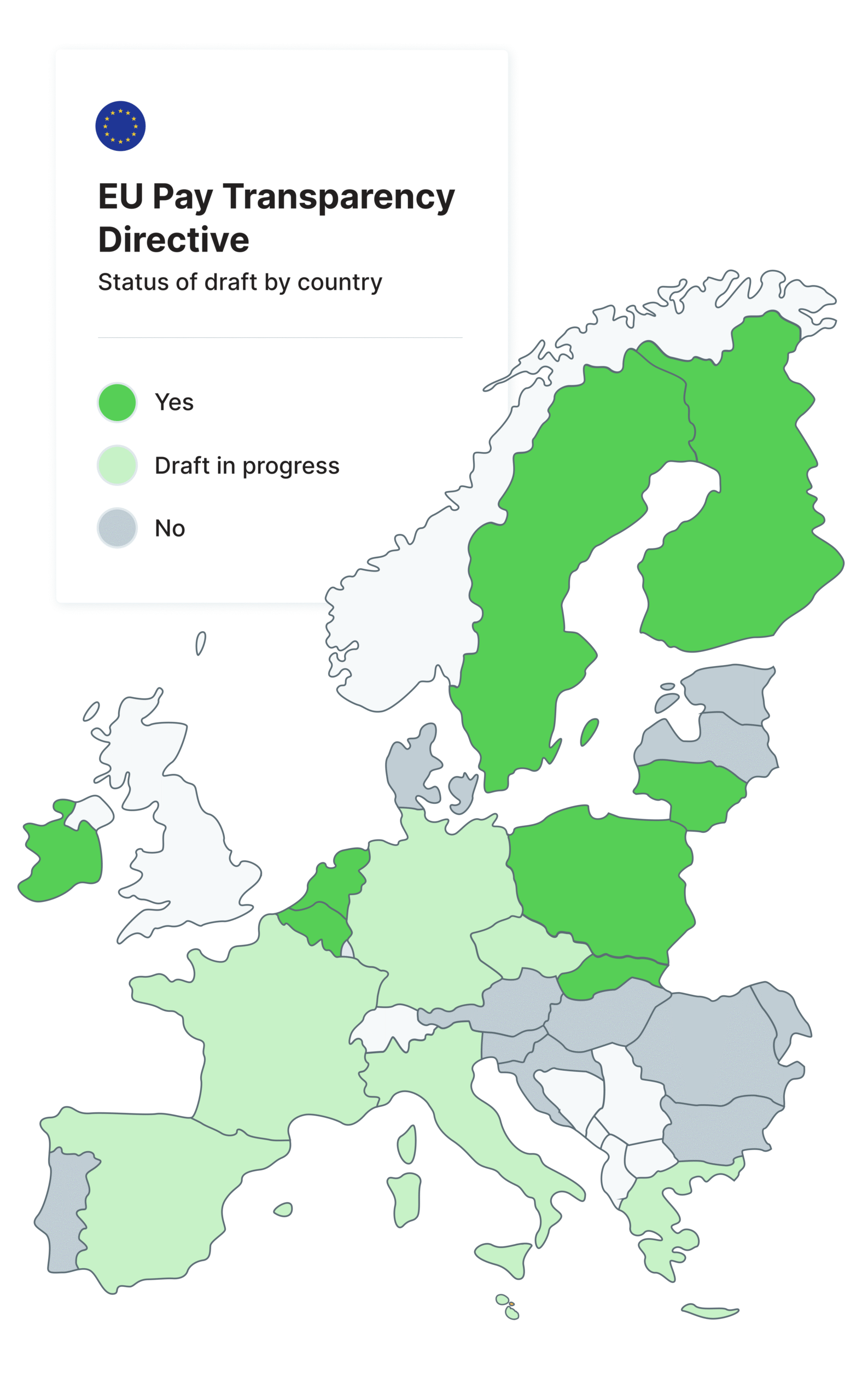
Keeping up with the status of each member state is time-consuming and complex. To help, our team of experts has compiled this status tracker showing where all 27 member states stand on transposing the EU Pay Transparency Directive — and guidance for how to get ahead of compliance and set yourself up for success.
Current status of transposing the EU Pay Transparency Directive, by member state
| Member State | Status | Draft Legislation | Final Legislation | Effective Date |
|---|---|---|---|---|
| Austria | No official announcement yet | No | No | Not yet set (must be by 7 June 2026) |
| Belgium |
On 12 September 2024, Le Parlement de la Communauté Française (Fédération Wallonie-Bruxelles or FWB) transposed the EU Pay Transparency Directive. While this only applies to employers subject to the jurisdiction of the Fédération Wallonie-Bruxelles, it may provide a roadmap as to how this will be adopted across Belgium. On 26 January 2026, the House of Representatives of Belgium issued a proposition de résolution (a resolution proposal) calling on the federal government to implement the EU Directive (EU) 2023/970 across Belgium. The government committed to implementing the Directive. Link to 26 January 2026 Resolution Proposal Link to FWB LawLink to 3 things to know |
Yes (for employers subject to the jurisdiction of the FWBs); No – but coming for rest of Belgium | Yes (for employers subject to the jurisdiction of the FWBs) | 2026 |
| Bulgaria | No official announcement yet | No | No | Not yet set (must be by 7 June 2026) |
| Croatia | No official announcement yet | No | No | Not yet set (must be by 7 June 2026) |
| Cyprus |
On 5 November 2025, the The Department of Labor Relations of the Ministry of Labor and Social Insurance put forth a draft bill entitled "The Strengthening of the Implementation of the Principle of Equal Remuneration between Men and Women for Equal Work or Work of Equal Value, through Wage Transparency and Enforcement Mechanisms Law of 2026". Link to Draft and Announcement |
Yes | No | Not yet set (must be by 7 June 2026) |
| Czechia |
No official announcement yet but Officials from the Ministry of Labour and Social Affairs have indicated a draft is in process. The “flexi-amendment” to the Labour Code banned pay secrecy beginning 1 June 2025. Link to Ministry of Labour and Social Affairs Progress Report |
No — but coming | No | Not yet set (must be by 7 June 2026) |
| Denmark |
On 26 February 2026, the Danish government published for consultation a draft law amending the Equal Pay Act. The Ministry of Employment notes the EU adopted legislation on pay transparency to strengthen the application of the principle of equal pay. Link to 26 February 2026 Consultation Draft Ministry of Employment Link to EU Directive Link to 3 things to know |
Yes | No | Not yet set (must be by 7 June 2026) |
| Estonia |
The Head of Gender Equality Policy indicated that the draft necessary to transpose the Directive is being prepared. Link to Gender Equality Policy Site |
No — but coming | No | Not yet set (must be by 7 June 2026) |
| Finland |
On 16 May 2025, the Finnish government published a draft addressing pay transparency and pay reporting obligations. On 22 December 2025, Finland’s Ministry of Social Affairs and Health requested statements on a draft government proposal to implement the Directive, with comments due 9 February 2026. Link to Draft Ministry of Social Affairs and Health Request Link to 3 things to know |
Yes | No | Not yet set (must be by 7 June 2026) |
| France | In May 2025, the French government launched formal consultations with trade unions and employer federations. A draft is scheduled to be released in late January. Letter from Department of Legal Affairs, Ministry of Economy, Finance and Industrial and Digital Sovereignty | No — but coming | No | Not yet set (must be by 7 June 2026) |
| Germany | New! On 17 July 2025, German officials announced formation of an 11-person Commission "Reducing Bureaucracy to Implementation of the Pay Transparency Directive" comprised of social partners, the Confederation of German Employers' Associations (BDA) and the German Trade Union Confederation (DGB), business associations. The Commission prepared a final report, published on 7 November, which was submitted to the Federal Ministry for Gender Equality. Now, the Federal Ministry for Gender Equality will initiate the legislative process for implementation of the law. Link to Information About Commission Commission’s Final Report Link to Summary | No — but coming | No | Not yet set (must be by 7 June 2026) |
| Greece | No official announcement yet but process to set up a working group has begun | No — but coming | No | Not yet set (must be by 7 June 2026) |
| Hungary | No official announcement yet | No | No | Not yet set (must be by 7 June 2026) |
| Ireland | On 15 January 2025, the Irish government published a draft addressing selective portions of the pay transparency requirements. Link to DraftLink to 3 things to know | Yes (but only for pay transparency) | No | Not yet set (must be by 7 June 2026) |
| Italy |
On 21 February 2024, Legge n. 15/2024 was published in the Gazzetta Ufficiale (GU n. 46 of 24 Feb 2024). It mandates the Government to issue implementing decrees before the EU deadline of 7 June 2026. On 3 February 2026, a draft of the transposition was issued. Link to Legge 14/2004 Link to 3 things to know |
Yes | No | Not yet set (must be by 7 June 2026) |
| Latvia |
The Latvian Ministry of Welfare indicated that “Latvia plans to adopt the minimum requirements of the directive by developing a separate, new regulatory act (law). Work is currently underway to transpose the requirements of the directive, both by working on an appropriate legal framework and by implementing other measures that will ensure the implementation of the requirements of the directive.” Ministry of Welfare Pay Transparency Directive Website |
No — but coming | No | Not yet set (must be by 7 June 2026) |
| Lithuania | On 27 May 2025, Lithuania’s Ministry of Social Security and Labour officially presented a draft bill to the Tripartite Council (employer associations, trade unions, government) proposing full transposition of the Directive.Labour Code changes (links to a Word doc) Administrative Code (penalties) changes (links to a Word doc) Link to 3 things to know | Yes | No | Not yet set (must be by 7 June 2026) |
| Luxembourg | On 17 November 2025, the Ministry of Labour indicated that a draft bill will be submitted to the Government Council. | No — but coming | No | Not yet set (must be by 7 June 2026) |
| Malta | On 27 June 2025, the Government passed legislation transposing selective portions of the pay transparency and right to information provisions. Link to LawLink to 3 things to know | Yes (but only for pay transparency and right to information) | Yes (but only for pay transparency and right to information) | 27 August 2025 (for pay range transparency and right to information) |
| Netherlands |
On 25 March 2025, the Dutch Government issued a draft implementing pay transparency and pay reporting requirements. On 17 September 2025, the Minister of Social Affairs and Employment, issued a letter indicating that The Netherlands is not likely to make the June 2026 transposition deadline, pushing likely entry into force in The Netherlands to 1 January 2027, with pay gap reporting not due until 2028. On 19 January 2026, the wage transparency bill was sent to the Council of State, officially kicking off the legislative process. Link to 19 January 2026 Draft Link to 25 March 2025 Draft Link to Update Link to 3 things to know |
Yes | No | Likely by 1 January 2027 |
| Poland |
On 23 June 2025, Poland published in the official journal a law implementing the pay scale disclosure and gender neutral job title transparency requirements. That law went into effect on 24 December 2025. On 16 December 2025, draft legislation was published for the remaining portions of the EU Pay Transparency Directive. Link to Pay Scale Disclosure Law Link to Draft Legislation Link to 3 things to know |
Yes | Yes (but only for selected portions of pay transparency) | 24 December 2025 (for pay range transparency and gender neutral job titles) |
| Portugal | No official announcement yet | No | No | Not yet set (must be by 7 June 2026) |
| Romania | No official announcement yet | No | No | Not yet set (must be by 7 June 2026) |
| Slovakia |
On 15 May 2025, Slovakia’s Ministry of Labour, Social Affairs and Family published a preliminary legislative notice revealing that a draft pay transparency law is in preparation and expected summer 2025. Slovakia published a draft of the Directive on 19 September 2025. On 6 January 2026, an updated pay transparency draft was formally submitted to the National Council for parliamentary consideration, marking its entry into the legislative process. Link to Draft Legislation Link to 3 things to know |
Yes | No | Not yet set (must be by 7 June 2026) |
| Slovenia |
The Ministry of Labour, Family, Social Affairs and Equal Opportunities indicated it is working on the implementation of the EU Directive on Pay Transparency together with project partners, including the Faculty of Economics, University of Ljubljana, the Diversity Charter of Slovenia. Ministry of Labour, Family, Social Affairs Website |
No — but coming | No | Not yet set (must be by 7 June 2026) |
| Spain | No official announcement yet; indication that draft is in process | No — but coming | No | Not yet set (must be by 7 June 2026) |
| Sweden |
On 29 May 2024, the Swedish Ministry of Labor and Employment received the investigative report into the implementation and transposition of the EU Pay Transparency Directive. This report includes draft legislation. In April 2025, the Ministry of Labour allocated $10M SEK for the development of a platform to collect pay reporting data. On 15 January 2026, the Swedish government published updated draft legislation titled “Genomförande av lönetransparensdirektivet”. This is the formal referral of the draft bill to the Council on Legislation (Lagrådet). Link to 15 January 2026 Draft Legislation Link to Report and May 2024 Draft Legislation Link to Article on Allocation of $10M SEK Link to 3 things to know |
Yes | No | Not yet set (must be by 7 June 2026) |
3 things to know about the Belgium Law: EU Pay Transparency Directive
- First transposition but regionally limited: First to fully transpose the Directive but only covers approx 7,500 mostly public sector employees subject to jurisdiction of Fédération Wallonie-Bruxelles.
- Strict pay range transparency: Goes farther than the Directive pay ranges must be shared as soon as job offers or ads are published.
- Pay reporting beyond the Directive’s baseline: Mandates reporting on the impact of family-related leaves on remuneration, disaggregated by gender and leave type.
3 things to know about the Cyprus draft: EU Pay Transparency Directive
- Clean transposition of the Directive: Cyprus largely sticks to the EU Directive’s baseline, implementing all core obligations on pay transparency, reporting, joint pay assessments, remedies, and burden of proof without materially tightening thresholds or timelines.
- Joint pay assessments zero in on post-leave pay progression: While generally aligned with the Directive, the Cyprus draft is unusually explicit about one risk area: joint pay assessments must examine whether women and men returning from maternity, paternity, parental, or carers’ leave benefited from pay increases granted in their specific worker category during their absence. This shifts attention from abstract averages to concrete career interruption penalties.
- Strong enforcement architecture despite softer process: Even with flexible consultation mechanics, Cyprus backs the regime with robust enforcement. Labour inspectors and the Ombudsman have clear investigative powers, sanctions can include fines and criminal liability, and the burden of proof shifts decisively to employers where transparency obligations are breached.
3 things to know about the Denmark draft: EU Pay Transparency Directive
- Delayed implementation and reporting timelines: The Danish draft delays implementation to 1 January 2027. Existing Danish gender pay reporting rules remain in force through 2027, with the first reports aligned to the Directive due in September 2028. Denmark openly acknowledges the delay, prioritizing administrative alignment and data integrity over strict deadline compliance.
- Directive-aligned, no significant gold plating: Denmark’s employer-friendly draft closely tracks the Directive without expanding obligations. There is no requirement to include pay ranges in job postings, no expansion of right to information duties, and no additional substantive transparency obligations beyond the Directive. Consultation requirements are calibrated to Denmark’s collective bargaining model.
- Government prepared reports with lowered threshold: Consistent with Denmark’s existing pay gap reporting model, Statistics Denmark will begin issuing Directive-aligned pay reports in 2028 for employers with 150+ employees. Employers with 100–149 employees and qualifying 50–99 employers will first report in 2031. Government reports will define categories of workers using DISCO codes, but employers remain responsible for ensuring categories reflect “work of equal value,” and many will likely need to conduct their own category of worker reporting. Denmark also extends limited reporting below the Directive threshold: employers with 50–99 employees are required to report where at least 8 employees of each gender fall within the same 6-digit DISCO group.
3 things to know about the Finland Draft: EU Pay Transparency Directive
- Reporting nuances, galore. Finland’s draft takes a layered approach: the government will calculate overall pay gaps for employers with 100+ workers using existing payroll data submitted to authorities, but employers are still responsible for analysing results down by category of worker. Meanwhile, existing rules remain: companies with 30+ employees must continue conducting a pay audit every two years as part of their Gender Equality Plan. Bottom line: three schemes, layered obligations, and more work for employers.
- Focus on taxable earnings: Because the government’s report is based on existing payroll submissions, Finland offers the clearest signal yet of what data will be required, and it’s centered on taxable earnings.
- Privacy flagged, but not solved. The draft acknowledges privacy concerns but stops short of clarity: there’s no numerical threshold for when information should be shared only with the works council instead of all employees.
3 things to know about the German Commission’s Report: EU Pay Transparency Directive
- Bureaucracy-light, detail-heavy. There is no draft law yet, but Germany is one step closer. A German Commission has issued its report outlining a “bureaucracy-reduced” model to guide lawmakers in drafting the Directive’s implementation, with a formal bill expected in early 2026. The report is not binding, but it is anything but shallow. It dives into definitions, data categories, and reporting mechanics. For employers, it’s the most comprehensive look yet at how Germany could operationalize the Directive’s right to information and pay gap reporting without drowning companies in red tape.
- Actual pay, pragmatic pay gap reporting. The Commission takes a firmly practical stance: pay gap reporting under Article 9 should be based on actual pay (2026 payroll data), not targets, calculated from the sum of all remuneration components but excluding outliers such as severance pay and allowing de minimis exemptions for small in-kind benefits. It recommends setting the reporting threshold at 100 employees, no lower. Together, these choices point to a manageable, employer-friendly compliance model.
- Right to information is delayed, but defined. The Commission recommends that the right to information under Germany’s future law apply for the first time in 2027 (either by 7 June 2027 or, according to some members, on 1 January 2027) while maintaining the existing law through 2026. Requests would be based on an annual snapshot, can be delivered digitally, and data from small comparison groups (fewer than six men and six women) would not be shared with employees due to privacy protections. One recommended addition from the Commission: include a clear description of how each “category of worker” is formed in the right to information report.
3 things to know about the Ireland Draft: EU Pay Transparency Directive
- Partial picture, gaps to fill: Ireland’s draft focuses on pre-employment transparency but omits rest, including pay gap reporting.
- Pay ranges in job posting: The draft requires pay ranges to be included in job advertisements, going beyond what is minimally required by the Directive.
- Alignment on salary history ban: Bans asking about prior pay, aligned with the EU Pay Transparency Directive
3 things to know about the Italy Draft: EU Pay Transparency Directive
- For “categories of workers” are primarily defined by collective bargaining not employer job architecture: Italy anchors “same work” and “work of equal value” in CCNL classification systems rather than employer designed job families. Comparability flows from contractual levels negotiated at sector level, not from internal job evaluation frameworks.
- Pay transparency is extended in two directions: harder at hiring, easier RTI at scale: Italy expands pay transparency beyond the EU baseline in a way that cuts both ways. On the front end, obligations are more demanding: job applicants must receive detailed pay structure information directly in job advertisements and vacancy notices, including the initial pay amount, pay components, and payment method, aligned to Article 1(1)(n) of Legislative Decree 152/1997. At the same time, Italy introduces a pragmatic compliance option for larger employers: those with 100+ employees may publish Right to Information data proactively on an intranet or restricted website, rather than responding individually to each employee request.
- Pay gap reporting allowed at the country level for some employers: For some employers, Italy allows gender pay gap reporting to reflect how pay is managed in practice: data may be reported at country level, rather than legal entity by entity, where a unified group pay policy applies.
3 things to know about the Lithuania Draft: EU Pay Transparency Directive
- Extends existing reporting requirements: Lithuania’s Social Security institution already publishes monthly average pay gap data. Under the draft, employees or their representatives can now request job category level gap data once a year (if there are at least two employees in that role). If the gap exceeds five percent, employers must explain or fix it.
- Pay scale transparency is not new: Pay scale transparency is already the law in Lithuania. However, now the draft makes clear that the collective agreement applicable to the position must also be provided before discussing or signing the employment contract, in line with the requirements of the EU Pay Transparency Directive.
- Formal pay systems, with no more size exemption: Lithuania already required companies with 20 or more staff to co-develop formal and gender neutral pay structures. Now every employer, regardless of size, must do the same. Small firms are no longer off the hook.
3 things to know about the Malta Law: EU Pay Transparency Directive
- Early start, but narrow scope: Malta’s partial draft takes effect on 27 August 2025, a full ten months before the EU deadline. But it only covers pre employment transparency for now. The rest of the Directive is still in waiting.
- Pay scale can wait: Unlike some countries pushing for upfront clarity, Malta allows employers to delay disclosing pay ranges and applicable collective agreements until just before the job starts. Applicants could accept offers with limited visibility into pay structure.
- Limited right to information: Employees can request pay data, but only for average pay of others doing the same work. There is no right to know pay for work of equal value, as required by the Directive. Employers still have have sixty days to respond.
3 things to know about The Netherlands Draft: EU Pay Transparency Directive
- Stays truest to the Directive but implementation likely delayed: The Netherlands has proposed a draft of both pay transparency and pay reporting requirements that is the closest to a clean implementation of the EU Pay Transparency Directive we’ve seen so far. The NEW! catch: the implementation deadline is slipping. The Dutch legislation will likely not go into effect until 1 January 2027. For gender pay gap reporting, this means that employers with 150+ employees will first report on 2027 pay data (not 2026), likely in June 2028. Employers with 100–149 employees will stick to the Directive’s original timeline: reporting in June 2031 on 2030 data. The transparency obligations are expected to apply starting 1 January 2027.
- Pay is broad and more guidance is coming: Takes a broad definition of pay that will be included in pay gap reporting and right to information. Only employer-wide costs not tracked at the individual level are excluded, keeping reports standardized and comparable. More definition of wages coming soon.
- Temporary workers may be included in pay gap reports for the “host” company: Under the draft, temporary agency workers made available under the Allocation of Workers by Intermediaries Act should be counted in the pay data of the company they’re working for, not the staffing agency that employs them. Will it survive? This approach sparked significant criticism in the public comments. The core concern: companies argued they don’t set the wages for these workers, so holding them accountable for the agency’s pay decisions could distort results and create liability without control.
3 things to know about the Poland Law and Draft: EU Pay Transparency Directive
- Piecemeal rollout with an accelerated start date: Poland split implementation into stages. Pay range transparency and gender neutral job titles have already been enacted, with an effective date of 24 December 2025. The remaining Directive obligations are still in draft and subject to further legislative process.
- Right to information timelines likely to be tightened, but not at the most extreme end: The draft proposes reducing the response deadline for right to information requests to 30 days, compared to 60 days under the EU Directive. Earlier drafts proposed even shorter timelines. Poland also goes beyond the Directive by fixing an annual notification date. Employers must notify employees by 31 March each year of their right to request pay information.
- Reporting starts at 100 employees with compressed explanation timelines: Mandatory gender pay gap reporting begins at 100 employees, with reports due by 31 March. If a trade union or equality body requests explanations, employers have 14 days to respond. In practice, this means employers will need to be ready to explain pay gaps early in the reporting process, not after filing.
3 things to know about the Slovak Draft: EU Pay Transparency Directive
- Full scope implementation, on time: Slovakia’s draft covers both transparency and reporting requirements and is expected to take effect on 1 June 2026. The government confirms that the goal is clean transposition. There are no lowered thresholds, no enhanced requirements, and no new pay gap reporting requirements. While there is no significant gold plating (save the changed reporting deadline), there is helpful operational guidance and a few tweaks.
- Pay gap reporting cycle changes: One tweak is a change to future pay gap reporting deadlines. The 6 January 2026 pay transparency draft that was formally submitted to the National Council for parliamentary consideration, introduces a 15 April deadline for filing pay gap reports. While an earlier draft proposed that the earlier reporting deadline would not apply to the initial reporting, the latest draft in Slovakia moves up this deadline.
- Somewhat more guidance on job categories and pay criteria: While there is nothing earthshattering, the draft provides some helpful guidance on how to group employees by the value of their work, how to apply career progression criteria, and what counts as a legitimate reason for pay differences. The definition of pay is broad, covering bonuses, benefits, and in-kind compensation, just as required under the Directive.
3 things to know about the Sweden Draft: EU Pay Transparency Directive
- First and extensive: Sweden was the first to publish draft legislation in 2024, delivering detailed article-by-article guidance, the most detailed proposal to date. A more recent draft in 2026 further clarifies and simplifies compliance in Sweden.
- Complex and bespoke reporting: Sweden’s 2024 draft proposed keeping its existing, highly detailed pay analysis regime and layering EU Pay Transparency Directive reporting on top. The 2026 draft doubles down. It creates a two track system in which employers with 100 or more employees must publish EU Directive-aligned pay gap reports, while employers must still carry out Sweden’s national pay analyses (equal work, equal value, lesser value), with written documentation required from 25 or more employees. The draft also adds a new obligation to analyze pay development following family related leave. The result is not simplification but added complexity. In practice, the 2026 proposal is more complex than the 2024 version.
- Right to information: use what you’ve got: To meet employee requests, employers can rely on their existing annual pay analyses. There’s no requirement to refresh data outside the annual cycle.
How leading brands are preparing
The EU Pay Transparency Directive must be transposed by 7 June 2026, then reporting follows on 7 June 2027.
This may feel far away — but since the first report is based on 2026 salaries, this compensation cycle may be your last chance to make changes before your pay gap data is “locked in” for public reporting.
Now is the time to straighten out your data, flag inequities, and start fixing them — paving the way for a narrative of progress and success in your upcoming reports. Don’t run out of time to correct pay gaps incrementally, in the most efficient and cost-effective way, before you have to share them publicly.
Syndio can help you get prepared. Our proven enterprise platform speeds up analyses, offers remediation strategies, and streamlines reporting. From there, you'll be well positioned to address the other requirements of the Directive, from posting equitable salaries to confidently communicating about pay — whether responding to an individual employee's questions or sharing a broader corporate narrative.
Get all the resources you need to start preparing for the EU Pay Transparency Directive, including a compliance guide, cheat sheet, FAQs, and global pay reporting calculator. Our team can also show you how our platform helps put your organization ahead.
The information provided herein does not, and is not intended to, constitute legal advice. All information, content, and materials are provided for general informational purposes only. Links to third-party or government websites are offered for the convenience of the reader; Syndio is not responsible for the content on linked pages.