HR leaders are under intensifying pressure to unlock productivity and talent advantages with AI. While the promise is real, so are the risks: data exposure, bias, weak controls, and compliance issues. In the high-stakes environment of compensation, every pay decision, from new hire offers to promotions, must be disciplined, accurate, and defensible.
To cut through the noise, your HR, legal, and compliance teams need a clear framework for vetting AI vendors. We’ve distilled the essential criteria into five must-ask categories of questions to ensure your chosen AI solution is safe, compliant, and trustworthy.
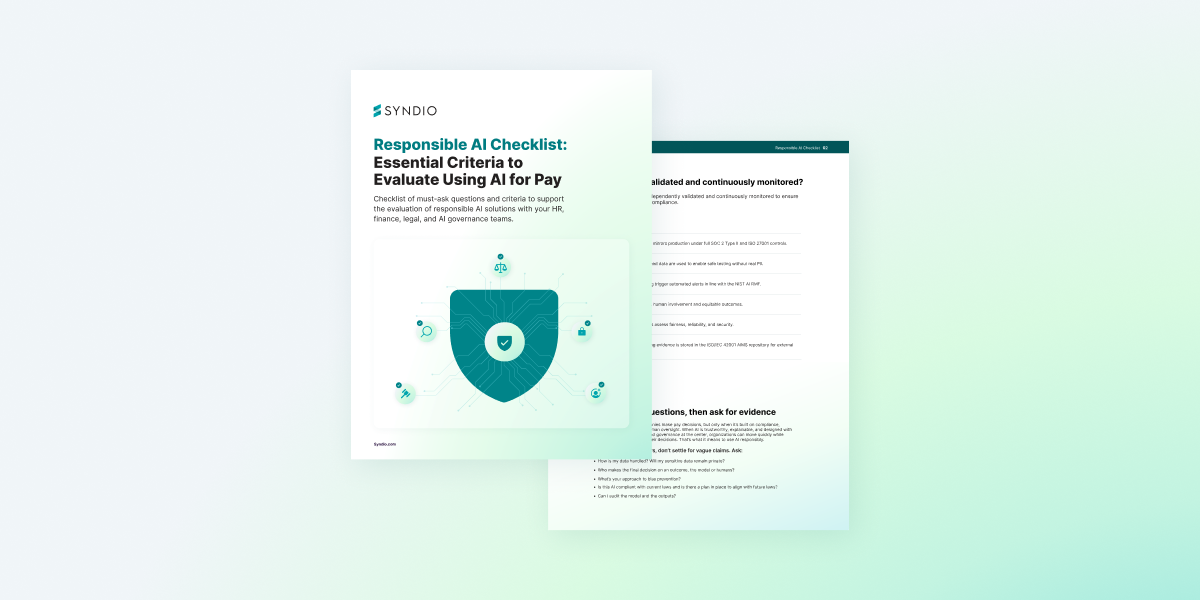
Get the full checklist: Following is a summary of core criteria to verify when evaluating AI for pay solutions. For a comprehensive list of evaluation questions and more detailed examples of specific artifacts to request from vendors, use the full checklist included at the end.
1. Is my data protected?
Not all AI is built on the same foundations. Many tools rely on general-purpose Large Language Models (LLMs) trained on customer data, which can lead to data leakage and IP risks.
Ask your vendor:
- Is identifiable compensation and employee data ever incorporated into shared or general-purpose model training?
- What mechanisms ensure customer data is siloed and never used for cross-customer learning?
- Is all activity logged in a secured audit repository to ensure traceability?
The standard: Your sensitive data should only be used to train tenant-siloed models that serve your organization exclusively. Only Anonymized and Aggregated Data (AAD) should be used to train underlying models, following a process that removes direct identifiers and pseudonymizes quasi-identifiers.
2. Can I understand and override what the AI recommends?
Explainable decisions are critical for those accountable for pay outcomes to be able to defend them. AI should function as a decision-support tool, never making a final decision automatically without human approval.
Ask your vendor:
- How does the solution ensure every suggestion is explainable to the average human reviewer?
- Are results flagged for human review when models lack sufficient confidence, rather than providing incomplete or false results?
- What controls allow users to override, modify, or ignore recommendations?
The standard: The solution must use a human-in-the-loop workflow. Every AI suggestion should provide clear logic and traceable reasoning to allow for sufficient scrutiny into the output, and the final execution on a decision should be conducted by a human.
3. What steps are in place to prevent bias?
Bias in AI often comes from subtle proxies like names, pronouns, or resume review order rather than just explicit fields like race or gender.
Ask your vendor:
- What methodology is used to exclude or mitigate protected-class indicators?
- Does the model governance process include internal red-teaming and drift monitoring?
- How frequently are regular bias audits conducted?
The standard: A bias-measurement model should run continuously and should expand to subtle proxies beyond overt bias indicators. Look for a governance process that includes quarterly audits.
4. Is the solution aligned with the EU AI Act?
As the most restrictive global framework, aligning with the EU AI Act ensures you are likely prepared for the highest levels of global regulatory requirements for implementing AI.
Ask your vendor:
- Is the solution aligned with EU AI Act requirements such as mandatory human oversight, transparent outputs, versioned audit trails, and controls to prevent over-automation?
- Does the solution follow SOC 2-compliant controls?
- Are model logic and sources accessible so customers can audit the basis for guidance at any time?
- Is clear documentation maintained and provided on how models are built, tested, and improved over time, including a human-led escalation system for any AI response?
- Does the vendor conduct post-market monitoring with quarterly AI risk reviews?
- How is the vendor staying prepared to adhere to future developments in AI standards?
The standard: Look for providers who follow SOC 2-compliant controls and provide detailed technical documentation including model lineage, validation metrics, and versioned audit trails. The vendor should have processes in place that they can share with you on how they will adapt their solution to evolving standards.
5. Is there an audit trail for the AI-generated outputs?
Pay decisions carry high legal and financial stakes. Audits must deliver concrete evidence that the system is fair, accurate, and aligned with your pay philosophy.
Ask your vendor:
- Does every recommendation show the specific logic and data inputs used?
- Can external auditors securely access time-stamped logs for compliance reviews?
- Are disparate impact tests conducted during pre- and post-processing?
The standard: Recommendations must use plain-language rationale to ensure a comprehensive decision history that is easy for all levels to interpret. Vendors should provide access to fairness reports, explainability outputs, and validation logs as independent verification evidence.
Adopt AI with confidence
AI can transform how companies make pay decisions, but only when it is built on transparency and strong human oversight. When evaluating vendors, don’t settle for vague claims; ask for verifiable artifacts.
Check out the full Checklist: Evaluate responsible AI solutions for pay decisions to give your legal, compliance, and AI governance teams the concrete standards and verifiable artifacts they need to run a consistent, disciplined screen of every AI vendor.
The information provided herein does not, and is not intended to, constitute legal advice. All information, content, and materials are provided for general informational purposes only. The links to third-party or government websites are offered for the convenience of the reader; Syndio is not responsible for the contents on linked pages.
FAQ’s
What are the most important criteria for a responsible AI solution?
Syndio recommends that you ensure comprehensive data protection; human-in-the-loop workflows, overrides, and decision making; bias prevention; alignment with all global AI regulations, including the EU AI Act; and defensible audits for internal and external stakeholders.
Why is vetting for responsible AI critical for compensation?
Compensation decisions carry significant legal and financial stakes. Because pay decisions must be defensible to regulators and auditors, any AI used must provide transparency, including a comprehensive decision history and plain-language rationale that a human can understand, explain, and verify.
What are some red flags in AI solutions?
Red flag #1 — “Black box” recommendations: The tool provides outcomes (like a specific salary number) but cannot explain the specific logic or data inputs used to reach that result.
Red flag #2 — Data pooling and leakage: Your organization’s sensitive, identifiable compensation data is incorporated into a shared model used by other customers rather than being kept in a tenant-siloed environment.
Red flag #3 — Fully automated decisions: The system allows for final execution on a decision without a mandatory human-in-the-loop workflow for review and approval.
Red flag #4 — Lack of verifiable artifacts: The vendor makes vague claims about fairness but cannot provide concrete evidence such as third-party bias audits, SOC-2 reports, or time-stamped validation logs.
Red flag #5 — Static or narrow bias testing: The vendor only checks for overt bias (like race or gender) but ignores subtle proxies (like names or resume order) and does not conduct regular, quarterly audits.
Red flag #6 — Poor auditability: The tool lacks a versioned audit trail, meaning you cannot recreate the exact model logic used for a specific decision if challenged by an auditor later.
How does the EU AI Act impact companies operating outside of Europe?
Even if your organization is based outside of the EU, the EU AI Act applies when you place AI systems or GPAI models on the EU market or when their outputs are used in the EU, and it represents the most restrictive global framework for AI. Treating the Act as your benchmark and vetting vendors against these standards ensures your organization is likely prepared for the highest level of global regulatory expectations as similar regulations inevitably evolve in other regions.
What are the practical signs that a vendor is using "vague claims" instead of verifiable artifacts?
A vendor may be providing vague claims if they cannot produce specific technical documentation, such as model lineage, validation metrics, or SOC 2-compliant controls. To properly vet a responsible AI solution, insist on seeing documentation that shows how they address each claim.
What is a "human-in-the-loop" workflow in AI compensation tools?
A human-in-the-loop workflow means that the AI functions as a decision-support tool rather than an autonomous decision maker. Every suggestion provided by the AI includes traceable reasoning, and the final execution of any pay decision is performed by a human reviewer.