In our latest webinar, Hywel Jones, VP of Total Rewards at TD SYNNEX, joined Syndio CEO Maria Colacurcio to share how TD SYNNEX is rethinking HR for an AI-first future. Jones shared his “north star” principles for AI-first transformation, top tips for getting started with a successful pilot, and why compensation is a high-impact use case to start driving ROI with AI.
The hidden cost of disconnected pay decisions
HR teams are on the hook to adopt AI in ways that quickly deliver measurable value, and increasingly, they have their sights on applying AI to guide pay decisions.
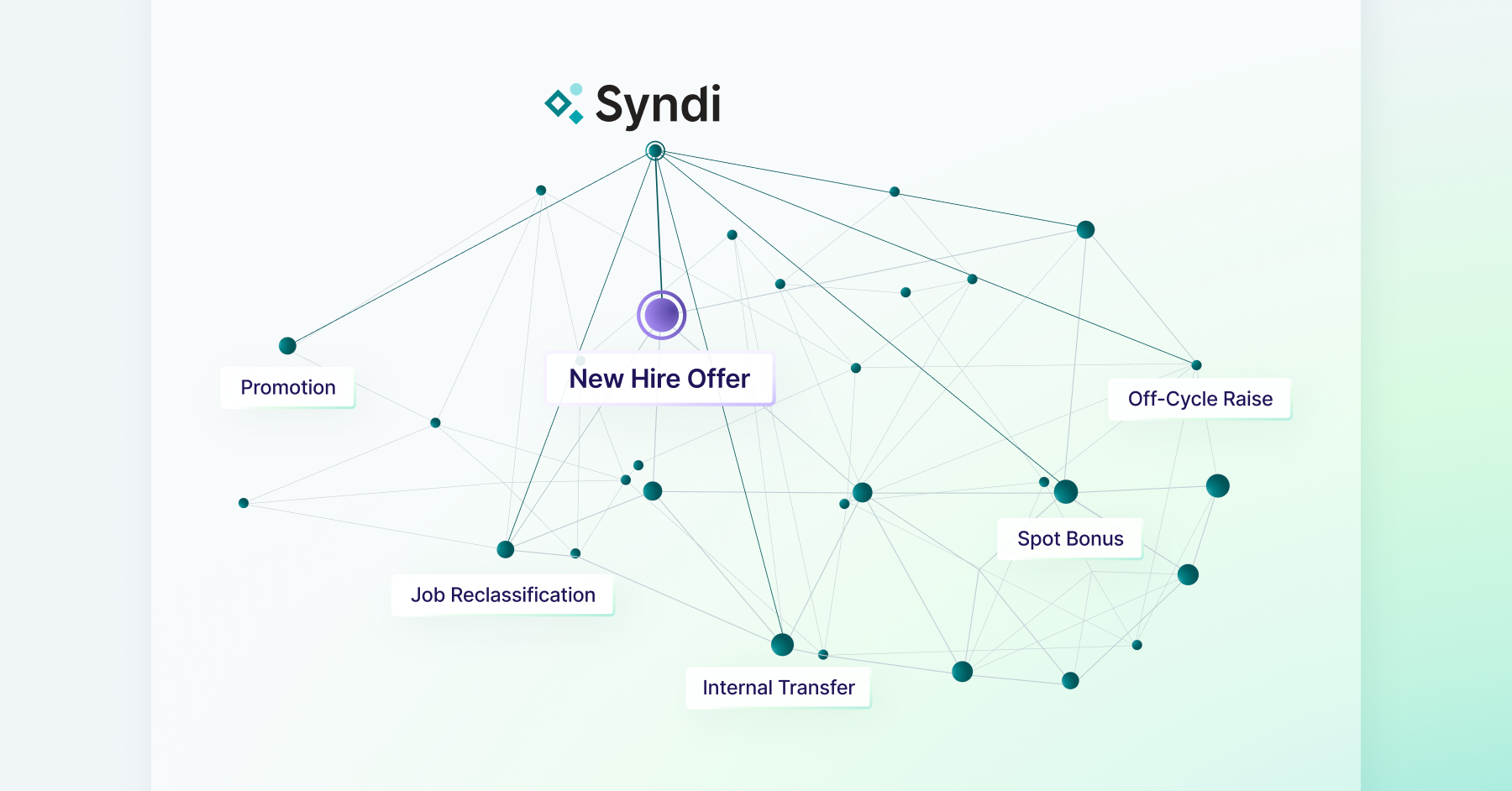
In most companies, compensation decisions happen across dozens of touchpoints over an employee’s tenure: recruiters extend an offer, managers handle merit cycles, HR approves promotions and market adjustments, and finance sets budgets. The trouble is that these groups often operate in siloes and each decision is treated as an isolated transaction — when actually, compensation should behave more like a network, with each node connected to the next. When the nodes don’t share context, decisions are inefficient, costly, and introduce risk that impacts pay equity, compliance, and culture.
AI provides a way to connect every decision in a way that wasn’t possible before. “It’s not about AI replacing human expertise,” said Maria Colacurcio, CEO of Syndio, during the webinar. “It’s that AI finally gives leaders that network-level information, knowledge, and intelligence that humans can’t hold.”
How TD SYNNEX is approaching AI transformation for HR
As Hywel Jones, VP of Total Rewards at TD SYNNEX, covered in the webinar, he and his team are transforming Total Rewards to be AI-first. They’re using these five principles as the guiding framework.
Fairness and equity are paramount.
Pay equity extends beyond compliance measures and becomes a cultural statement about your company. Jones emphasizes that fairness must run through everything to eliminate bias from decision making at the root.
Performance matters.
AI should be used to drive measurable business outcomes. This includes ensuring pay decisions are consistent and reward those who deliver the highest value.
Consider global consistency versus local nuance.
There needs to be a balance in meeting all global and local regulations, including complying with the EU Pay Transparency Directive and adhering to U.S. state laws, for example. The goal is to build a global framework that is robust enough to handle the “stress test” of local legal and cultural differences.
AI is augmentation, not replacement.
Jones views AI as a “buddy” or support system rather than a replacement. In high-impact areas like compensation decisions, AI insights must always be paired with human judgment and explainability. AI can help recruiters and managers articulate the “why” behind an offer, building trust with candidates and employees.
“Explainability is about credibility,” said Jones. “Pay decision making is typically not about the dollar value at the end; but if the individual understands why a decision is being made.”
Work where people work.
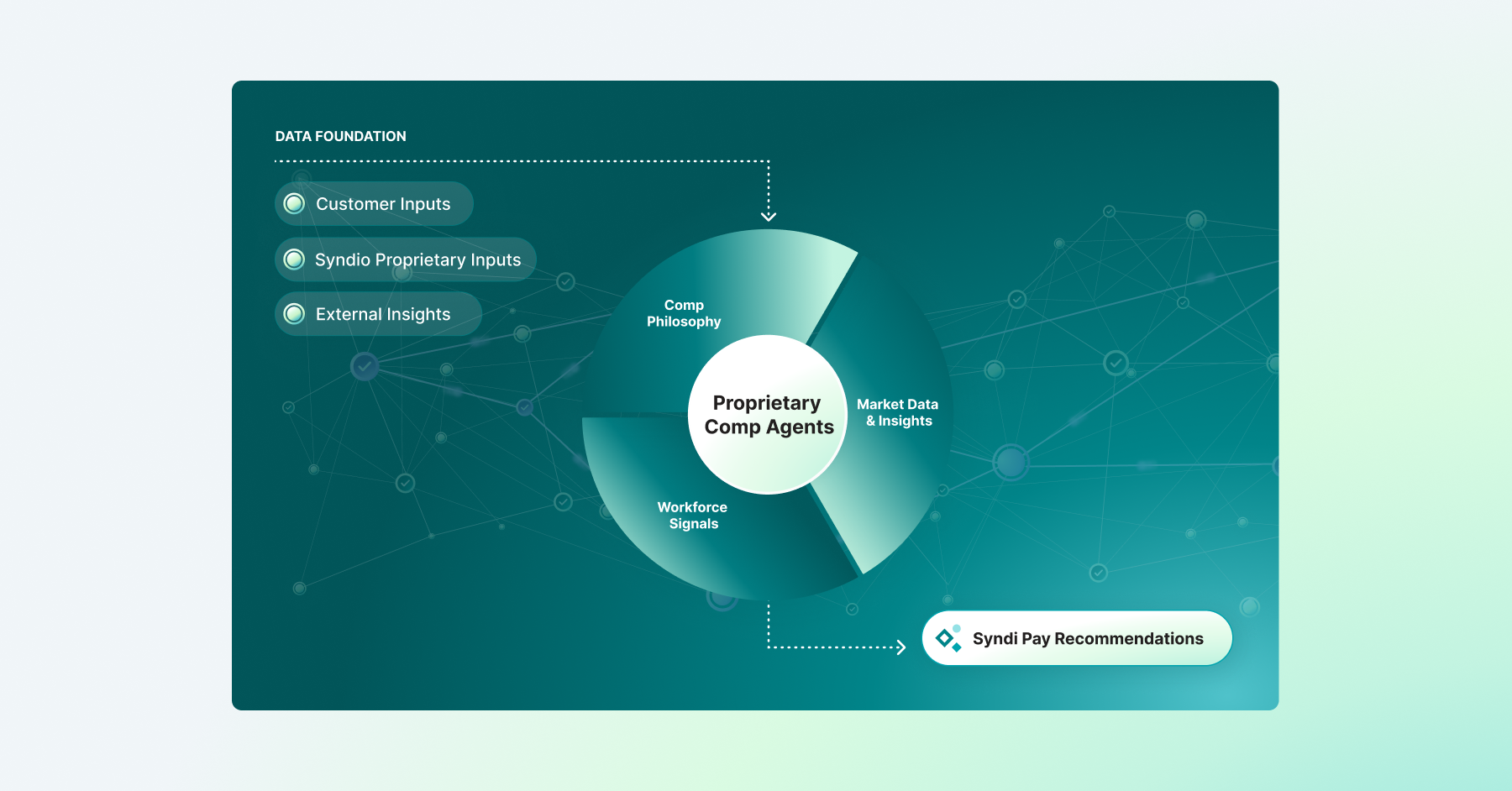
As Jones explained, adoption will be most successful if AI tools are embedded directly into the existing flow of work, such as how Syndio is developing Syndi to make pay recommendations in systems HR teams already use. “How people actually work is so critical to build into the product,” he said.
According to Jones, AI and automation should enhance the experience and impact of the decisions we’re making, especially in a space as nuanced and deeply human as compensation. HR leaders should look for systems that think with them, that are embedded in how they work, and help people make better decisions in real time.
4 tips to kick-start AI transformation: leadership buy-in, data, and pilots
AI transformation is a journey, not something that happens overnight. As Jones shared during the webinar, don’t try to boil the ocean. Instead, success comes from identifying high-impact use cases to start with, informed by the principles described above.
Jones offered these four practical steps to get started.
1. Secure executive sponsorship beyond HR.
When kicking off AI transformation in HR, cross-functional buy-in unlocks the support needed to launch pilots and turn early experiments into successful, scalable outcomes.
One of the most critical missteps companies make is treating compensation solely as an “HR problem.” To get buy-in and drive adoption, it’s important to highlight how compensation initiatives impact risk mitigation, cost efficiency, and operational excellence.
At TD SYNNEX, this shift in perspective was driven by executive sponsorship outside of the traditional HR silo. By engaging the CFO early, Jones was able to elevate the pay decision conversation from a compliance checkbox to a strategic business objective.
As Jones said, “Our CFO was the face of the messages and allowed us to gain traction around seeing this as a business imperative, not just an HR one.”
2. Start with pilots to “fail fast” and iterate.
Jones advocated for controlling the “blast radius” of AI implementation by starting with small, meaningful pilots. This approach allows teams to test the model, validate insights, and iterate without the pressure of a full-scale global rollout.
Think of this phase as a “test kitchen,” he said. For example, if you’re applying AI to pay decisions, you may look at new hire offers for a single job band. Starting small allows you to quickly uncover improvement areas and build confidence in the system before expanding.
3. Identify pilot use cases based on business outcomes.
High-priority business outcomes should be the north star for identifying which use cases are prime for AI transformation. “We’re in an age where AI is in our faces all the time,” said Jones. “The AI market is absolutely saturated with vendors that will offer you everything. Start with business-led outcomes and be clear about what you’re solving for.”
4. Don’t wait for perfect data.
A common barrier to AI adoption is the belief that data must be pristine before any technology can be implemented, but the reality is that no organization has perfect data.
Instead, view the implementation process itself as a data-cleaning mechanism. Finding and fixing data gaps during implementation can be a benefit, not a blocker. Start with the data you have, use the tools to identify the errors, and clean as you go.
Final thoughts: Center humans in your AI transformation initiative
However you approach an AI in HR initiative, focusing on the employee experience every step of the way will pay dividends. In wrapping up his recommendations for AI transformation, Jones emphasized that “The communication and change management efforts are critical.”
Missed the webinar and want to learn more about how Syndi is using AI to transform pay decisions? Request a demo.
The information provided herein does not, and is not intended to, constitute legal advice. All information, content, and materials are provided for general informational purposes only. The links to third-party or government websites are offered for the convenience of the reader; Syndio is not responsible for the contents on linked pages.